The Limousine Liberal by Steve Fraser
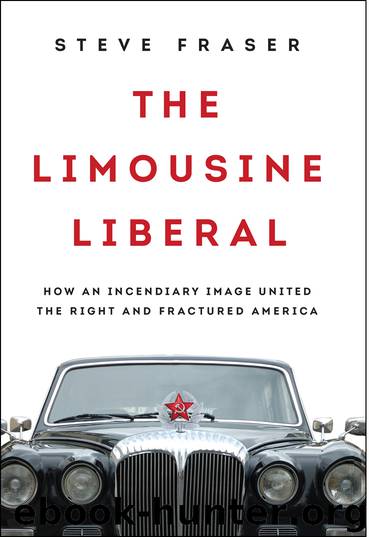
Author:Steve Fraser [Fraser, Steve]
Language: eng
Format: epub
ISBN: 9780465097661
Publisher: Basic Books
Published: 2016-03-22T00:00:00+00:00
THE NEW CLASS
Country and western Marxists were prey to racial prejudice. About this there can be no doubt. Race as a biological category is an elusive one at best. But metaphorically speaking, American culture has been a genetic carrier of racism since birth. So the lower orders were infected along with everybody else. However, what country and western Marxists also evinced but what mainstream American culture after World War II had difficulty seeing or acknowledging was the way social class defined and disfigured national life. The silk-stocking crowd that Wallace, Hicks, and others excoriated was indeed part of the vanguard of reform. Moreover, it gathered around it a new group of adherents. They didn’t dress in silk stockings or socialize on Park Avenue. They often opposed the war in Southeast Asia that the silk-stocking crowd had authored; indeed, it would be hard to overstate their visceral hatred. The irony here is palpable, however, because they shared something essential with the world of thoroughbred, ruling class reformers: namely, its self-righteousness and its disdain for the underworld of white “little men.”
Postwar American capitalism was evolving. One quarter of the labor force now consisted of professional and technical workers, engineers, managers, public sector bureaucrats, and proprietors. John Kenneth Galbraith identified them in 1958 as a “new class.” This was an exceedingly diffuse economic and sociological category. Those loosely fitting into it hardly subscribed to the same worldviews and political allegiances. Nor did they occupy conspicuous positions in public life, neither in the political arena nor as household names in popular culture. They were rather the anonymous legions of the salaried middle classes flooding the arteries of the new service, financial, and high-tech sectors of the economy. Moreover, during the years that followed, especially in the Reagan years or what some might call the “second Gilded Age,” which others labeled the era of neoliberal capitalism, this species would grow in number, in the variety of functions it performed, and in the endless novelty of its lifestyles.
Nonetheless, even in this earlier, formative era, prototypes of this new class made their presence felt as they occupied positions of considerable power. Well-educated, cosmopolitan in outlook, and enjoying the material prerogatives of upper-middle-class living, they were proud of their technical and organizational efficiency and expertise. It was, after all, their principal form of human capital, which lodged in the neurons and synapses of their highly trained brains. It gave them a sense of self-confidence when it came to devising or helping manage technical innovation and social upheaval. Insofar as they embraced an ethos of perpetual change and viewed any attachment to tradition as by definition pathological, they embodied the abstract logic of capital itself captured in Marx’s celebrated aperçu, “All that is solid melts into air.” They were the twentieth century’s architects of progress. And in that common cause they tended to identify with the reform-minded liberal corporate elite then running the country.
They didn’t summer in the Hamptons or make truly strategic decisions for corporate America, nor were they even necessarily shareholders.
Download
This site does not store any files on its server. We only index and link to content provided by other sites. Please contact the content providers to delete copyright contents if any and email us, we'll remove relevant links or contents immediately.
| Anarchism | Communism & Socialism |
| Conservatism & Liberalism | Democracy |
| Fascism | Libertarianism |
| Nationalism | Radicalism |
| Utopian |
The Secret History by Donna Tartt(19111)
The Social Justice Warrior Handbook by Lisa De Pasquale(12197)
Thirteen Reasons Why by Jay Asher(8921)
This Is How You Lose Her by Junot Diaz(6894)
Weapons of Math Destruction by Cathy O'Neil(6286)
Zero to One by Peter Thiel(5808)
Beartown by Fredrik Backman(5769)
The Myth of the Strong Leader by Archie Brown(5513)
The Fire Next Time by James Baldwin(5456)
How Democracies Die by Steven Levitsky & Daniel Ziblatt(5225)
Promise Me, Dad by Joe Biden(5159)
Stone's Rules by Roger Stone(5091)
A Higher Loyalty: Truth, Lies, and Leadership by James Comey(4967)
100 Deadly Skills by Clint Emerson(4935)
Rise and Kill First by Ronen Bergman(4797)
Secrecy World by Jake Bernstein(4756)
The David Icke Guide to the Global Conspiracy (and how to end it) by David Icke(4724)
The Farm by Tom Rob Smith(4517)
The Doomsday Machine by Daniel Ellsberg(4493)
